Thursday, February 21, 2008

Response to a Reader's Comment

Unfortunately, when someone comments on a post well after it was originally published, I'm probably the only person who notices. Yesterday, an anonymous reader responded to an article I wrote in November called, "Muslim St. Louis." One of the people I interviewed for that article was Dr. Khaled Hamid, a physician who has done volunteer work for the Council on American-Islamic Relations (CAIR). This year, Khaled also created his own blog, Khaled Hamid Forum, addressing issues related to Muslim communities in North America.

Here is the reader's comment:

"There is tremendous ignorance here"

I think that there is a lot of ignorance but Dr. Khaled Hamid is leading the march.

He should be directing his outreach to the huge number of apparently misunderstanding Muslims from Afganistan to Palistine to the Philippines to Britain to most of the Middle East who have shouted "Allah Akbar" before blowing themselves up along with fellow human beings.

Did he personally know any of his fellow CAIR officials which have been convicted of links to terrorism from Palestine to Pakistan?

He should be more concern that a huge number of his fellow participants in Islam have somehow gotten the idea that Allah commands that they should kill non-believers.

I don't know how it happened or really care but they should fix it!

My initial response to this comment is one of frustration and anger. Even in such a limited space, this person manages to present a serious contradiction regarding the issue of ignorance. From, "I think there is a lot of ignorance but Dr. Khaled Hamid is leading the march," to, "I don't know how it happened or really care..." the reader challenges Dr. Hamid's perspective as narrow and misguided, then relieves her or himself of any responsibility to understand or even care why acts of terrorism are being committed throughout the world.

In this case, I don't think that understanding--as in understanding the political and social contexts in which such crimes occur--requires sympathy or even empathy with the perpetrators of violence and cannot be confused as an effort to justify the actions of those individuals.

As Khaled writes in his blog, addressing Palestinian attacks on Israeli civilians, "To understand where the anger and rage are coming from is healthy, and helps all of us: Muslims, non-Muslims, Arabs, and non-Arabs, get to the real source of the problem of violence:
Injustice, and try to help solve the cycle of violence. But through out all this, we SHOULD NOT ever accept such a deed, or try to justify it. Understand it: Yes. Condone, accept, or justify: Never. Speak against it, and try to stop it from happening: Always" (link to post).

I also don't believe that Dr. Hamid, an American, is more accountable for the actions of a Hamas militant or an Al-Qaeda operative than any other American. Why should he be? Because he's a Muslim? I have trouble understanding a world in which Khaled is responsible for the actions of someone who has grossly misinterpreted the religion that he happens to practice.

At the same time, if I said that Khaled Hamid and other American Muslims should not be compelled to denounce acts of terrorism committed in the name of Islam, I think he would disagree with me. Consider his recent blog post, "Suicidal or not, targeting civilians is immoral and criminal" or that, as I mentioned in my article, he participated in a conference shortly after the June 30th bombing of Glasgow International Airport last year, during which local physicians spoke out against terrorism.

As for this reader's question, "Did he personally know any of his fellow CAIR officials which have been convicted of links to terrorism from Palestine to Pakistan?" I'm not surprised by this attempt to undermine an established and effective civil liberties group.

Honestly, I'm not well enough informed or even compelled to respond to such a vague assertion, but the tactic is familiar. In the face of an organization, such as CAIR, that advocates for civil rights, principally through mediation and education, and seeks to promote a positive image of the communities it serves, critics are left with accusations capable only of conjuring the negative images and associations that the media already provides.

So, that's my initial response. Upon more careful consideration, I acknowledge the basic sentiment that seems to be at the heart of this reader's comment--
that horrible atrocities are being committed every day throughout the world and that they will not stop occurring until someone intervenes.

It would be really nice if the global Muslim community (and I don't think such a thing exists) could simply turn to the problem of violence perpetrated in the name of Islam and "fix it," as the reader writes, but that is to deny that the rest of humanity is complicit in the tragedies and injustices suffered in this world. We, as Americans, have been made particularly culpable by the actions of our government, which (to say the least) has done everything in its power to make reconciliation between various ethnic and religious groups as well as widespread stability
nearly impossible in the Middle East.

So, in addition to individuals like Dr. Khaled Hamid, non-Muslim Americans should be speaking out against violence and acts of aggression, regardless of the actor's ethnicity, nationality or religion, whether over there or here at home.

I highly recommend that all readers visit Khaled Hamid's blog and contribute their ideas in the open forum that he provides. I will also point out to anyone who wishes to comment on this blog that anonymity is always an option, but that by selecting "other" in the comment posting section, you will be able to provide your name.

*Having just published this post, I found that another person has commented on the "Muslim St. Louis" article. I don't feel the need to dignify that comment by elaborating on what I've already written, but feel free to follow this link back to the article, where you'll find the comments at the bottom of the page.

Tuesday, January 22, 2008

Real Politiks

My parents announced that we were moving from Indiana to Colorado when I was in second grade. My best friend’s mom cushioned the blow with tickets to the Michael Jackson concert (Bad Tour, 1987). I only remember that Michael performed Billy Jean in silhouette before claiming the stage in a werewolf mask. I couldn’t dance or hear the music. God pressed his hand to my heart and I felt every rhinestone-studded finger.

At age ten, the greatest moment in my life was behind me. We’d been living in Littleton for three years. My faded concert t-shirt was declared “retarded” at school and my lips were constantly chapped. I had finally learned to ride a bike in an empty parking lot miles from our subdivision, but persisted on my push scooter. I played Nintendo and overate. The opportunity to sing I’m a Yankee Doodle Dandy for President George Herbert Walker Bush was a mercy I couldn’t refuse.

My choir teacher at Eagle Ridge Elementary must’ve been a political operative. We were a talentless bunch, but she shoved little flags in our fists and won us the honor of headlining a serious gig. The event was a fundraiser for a prospective state legislator and President Bush was lending some weight. Saddam Hussein hadn’t yet invaded Kuwait and the green specters of Patriot Missiles hadn’t lit up my tractable mind, but the President was obviously an important man.

As the date approached, I spent less and less time in my regular classroom, learning to smile with my eyes and sing from my gut.

I’m a Yankee Doodle Dandy
A Yankee Doodle, do or die
A real live nephew of my Uncle Sam
Born on the Fourth of July!

I’ll never forget this refrain, nor will I be as nauseous as I was the morning of the big day. After vomiting in the restroom at school, a teacher’s aide took me to the main office to call my mom. The rest of the kids were already loaded on the bus and my choir teacher showed little patience for a fallen soldier.

“I’m sick,” I told my mom.

“You’re just nervous. I think you should go.”

This was a familiar conversation. When I was in pre-school, my teachers had a note on file that said, If Ryan vomits, don’t send him home. Having already evacuated my breakfast, there was no excuse not to get on the bus.

By the time we arrived at the convention center, I was hungry. I probably snuck a few gummy fruits or traded up for a Lunchable. Our teacher and parent volunteers hustled us off the bus to be organized in gender-segregated lines. We entered a building that looked like an airplane hanger full of red, white and blue balloons. An interminable waiting ensued, measured only by a cycle of bathroom visits in six-person rotations. When we finally mounted the bandstand, I tried to look past the spectating sea and retain the sensation of hunger, which I preferred to its opposite.

The opening bars of You’re a Grand Old Flag cued the waving of our cheap little props and the audience gushed, but my gaze never left the old man in the blue suit. He couldn’t moonwalk or say anything memorable enough to be reproduced eighteen years later, but I sang for him because he was more significant than me or anyone I’d ever met. Actually, I just mouthed the words.

My career in the field of political pomp had been on hold until last Saturday morning. I woke up at six-thirty, put on a casual, but respectable sweater and got into my frozen car.

In a recent tussle with my friend Shannon over presidential predilections, I said something like, “It’s shallow, but if we have the opportunity to elect the first female or the first black president, why would we choose the white guy?” I aspire to more nuanced and substantive political thought, but when I really consider why I’m going to vote for Barack Obama on February 5th, it’s difficult to move beyond personal preference.

The leading candidates for the Democratic nomination are not the same. Their agendas are flecked with different points of emphasis that will have real effects in the world. Some of these differences are spelled out by Glass Booth, a refreshingly meaty website that found my political views in 91% alignment with Denis Kucinich. Huh.

Having waded through the gray waters of strategic messages and distorted attacks, I’ve identified the face that I want for our country, but I can’t sustain a very heated argument with a supporter from another Democratic camp.

So, why was I driving to a John Edwards rally at the Carpenters’ Union of Greater St. Louis? Honest answer: I wanted to be in the same room with someone famous.

I met Shannon and another friend, Lori, in the parking lot. It was too early and cold for ideological exchange, so I quietly shrouded myself in their Edwards love and slipped through the door. In the lobby, we signed in and received bumper stickers. I noted the complete and kind of alarming absence of security and that helium balloons are not a good way to promote an environmental record.

Lori, who had traveled to Iowa to document and participate in the caucuses, knew one of the event organizers. He asked if we, as young people, would be willing to stand on stage behind Edwards.

“Sure!” I said, overcome by that basic human desire to be seen on TV.


Inside the union hall, a huge American flag established a sense of production and Lori showed us the sign that she had made—the loveliest in the room.

I snapped photos of the gathering crowd and worked up the courage to approach two men who actually looked like they belonged at a union-sponsored event. Alex Gromada and Bill Dill were card-carrying members accompanied by Bill’s daughter, Sarah, who said she would be voting for the first time. Both men described themselves as undecided and were interested in getting specific information about Edwards’ platform.

“I’m pretty impressed just reading the flyer he’s got,” Bill said. “He’s not taking PAC [Political Action Committee] money from anybody. He wants the people to back him, not the corporations. So that’s pretty impressive right there.”

“About the NAFTA expansion,” Bill added, “he’s against that, so that’s going to help us out a lot too—keeping jobs here in America.”

When I asked Alex which issues he considered most important, he listed the economy, healthcare reform and ending the Iraq War. He also said that he didn’t think Edwards was getting as much attention in the media as Clinton or Obama.

After a difficult loss in Nevada, where Edwards only captured four percent of the vote, and in the face of South Carolina polls that have him trailing far behind (see the NY Times), that appears to be the case. Nonetheless, a roomful of people had shown up to hear the man speak and the buzz was making me giddy.

Shannon, who had to leave early, took over the camera work as Lori and I ascended to an elevated position. I felt like the least appropriate person in the room to be playing the stage prop. We stood amongst union men, signage bearing children and state legislators representing their various districts. One of the organizers helped us focus our efforts.

“I want to thank you guys for standing up here,” she said. “You are the face of John Edwards!”

“What we're looking for is engagement, so don’t fall asleep standing up. That would be really awkward. When he says something, don’t be afraid to clap, nod, wave your signs, that kind of stuff. And get to know each other. We have a lot of organizing to do to win this thing.”

From there, several speakers would do their part to warm up the crowd, including Alvin Reid, a journalist for The St. Louis American, who I found the most compelling.

“As I’ve spoken on behalf of the senator and the candidate for president of the United States, people have asked me, ‘Alvin, what are you doing up on that stage?’ and I tell them, ‘I’m doing the right thing.’”

“I’m not up here to make history and to try to prove something to somebody other than that the Democrats need somebody in the White House to work with the Democratically controlled Senate and the Democratically controlled House. Then we can get back to helping out people like you and I—people who work for a living, people who just want to raise their kids and be able to send them to college without going broke, be able to fix their car without taking out a loan, be able to do the things that I was able to do as a kid coming up with a father who was a printer and a mother who was a schoolteacher.”

“And if you’re a schoolteacher now or you're a union printer, you’re struggling. You’re trying to get by. And the White House, they’re laughing. They say, ‘Hey, I can send you sixteen hundred dollars and that’ll shut you up.’ Well you know what, we’re not gonna shut up! We’re gonna get John Edwards elected the next president of the United States!”

A few more speakers addressed the audience before a swell of applause brought Mr. Edwards on stage. I can’t say that anything about his appearance surprised me. I had seen plenty of him on television and listened to enough of his North Carolinian cadence that he felt familiar standing just a few feet in front of me.

His speech was broad and the points he made were expected, offering himself as the miner’s son ready for a fight, but I still marveled at the immense task with which he was engaged and his resilience in the face of it. Certainly that could be said about any of the candidates, but I haven’t stood behind them yet, goofing for the cameras.

*The last four photographs were taken by Shannon Connelly.

Monday, January 21, 2008

Dr. Martin Luther King Jr.

Democracy Now! today broadcast Dr. King's speech, "Beyond Vietnam," delivered at New York's Riverside Church on April 4, 1967. It's incredible.

Here are links to the program site and the audio stream.

Thursday, January 17, 2008

Canyon Run

The Tarahumara are the indigenous people of the Mexican state of Chihuahua. They live primarily in Copper Canyon, a system of six canyons that is larger and, in some areas, deeper than the Grand Canyon. Their population is estimated to be between sixty and eighty thousand, and for many years they have been fighting the encroachment of the mining and timber industries on their remaining ancestral land, which now represents the last one percent of old growth forests in the Sierra Madre Occidental.

Many of the Tarahumara continue to practice a traditional lifestyle—inhabiting natural, open-air shelters, farming subsistence crops, herding livestock across steep canyon terrain, observing religious and social ceremonies accompanied by
tesgüino, a mild beer made from fermented corn, and running—they do a lot of running.

The Tarahumara call themselves the Rarámuri, which means runners on foot in their own Uto-Aztecan language. Will Harlan, editor-in-chief of Blue Ridge Outdoor Magazine and himself an ultra-marathon runner, first became interested in the Rarámuri because of their reputation as, in his words, “the world’s greatest distance runners.” Amongst these people, both men and women have been known to travel up to a hundred miles in a single day, sometimes in the process of persistence hunting, the practice of tracking an animal to exhaustion.

In addition to ceremonial athletic competitions, a fifty-mile footrace is held every spring in which members of the indigenous community compete alongside world-class runners in an effort to raise money for clean water initiatives and seeds. In the 2006 race, Scott Jurek, considered one of top distance runners in the world, lost to Arnuflo Quirare, a Tarahumara farmer who was running barefoot.

Hoping to spread awareness about the struggle for indigenous rights, Will invited his cousin and documentary filmmaker, Ryan Wylie, and my friend, Phil Merker, to collaborate on a short film about the Tarahumara. On December 3rd, the three traveled to Chihuahua City and were received by employees of the Sierra Madre Alliance, a non-governmental organization that provides education, legal services and other forms of support to indigenous communities in the region.

Ryan, who co-founded Inner Mission Productions and the Free Form Film Festival, brought his video equipment, initially planning to document the Rarámuri’s efforts to sustain their community in the midst of a twenty-year drought. As it turned out, the rains had finally arrived in 2007 and the December visit placed the film crew in the canyon in the middle of the wet season.

Unfortunately, the much-needed rainfall is only one factor in securing the future of North America’s largest, traditionally practicing indigenous population.

Before traveling six hours to the city of Guachochi, where they would begin their descent into Copper Canyon, the team encountered a group of Rarámuri protesting on the steps of a government building. The demonstrators explained that they were petitioning the Mexican government to take action on a decades-old case for indigenous land rights. The fact that these people had brought their concerns to a state institution, rather than the appropriate federal one, exemplified the challenges they face in navigating a complicated and potentially corrupt bureaucracy.

With two Rarámuri men, Pedro and Santiago, and Valentine, Santiago’s twelve year-old son, as their guides, the Americans would hike for three days into Choreachi, the most traditional of the Rarámuri settlements. The first day’s push brought them to the Sinforosa River at the base of the canyon. On the hike down, they were accompanied by a stray dog that they recognized from town. Her single, protruding tooth gave her away.

The next day, with their donkeys, mules and new mascot, they ascended to the canyon ridge, logging another seven-hour trek.

The guides weren’t following a trail and the terrain was demanding. During the uphill climb, Phil experienced intense cramping in his legs and had to assume a deliberate pace. His frustration may have only been exacerbated by the presence of Valentine, standing by with a concerned look in his traditional footwear—sandals with a rubber sole fashioned from an old tire.

Despite the language barrier, the long hours of hiking established a bond between the filmmakers and their guides. When they arrived at Pedro’s home, a dirt floor structure on the outskirts of Choreachi, he invited them inside. Ryan later learned that this was a significant gesture as the Rarámuri’s shelters are strictly used for cooking and sleeping and are not often shown to outside guests.

This functional relationship to established dwellings was also evident in the center of the Choreachi settlement, which the group reached the following day. Here, a few basic cabins and an abandoned schoolhouse scattered across an open field constituted the heart of the community. During most of the year, the Tarahumara move nomadically throughout the canyon in relative isolation, but encampments like this serve an essential function as sites of congregation.

During their first evening in the camp, Will, Ryan and Phil shared a meal and watched the sunset. As the sky filled with color, Phil began to feel mildly nauseous and decided to boil some garlic water, which he was told would help protect him from parasites. After speaking with the guides, he also drank some tea made from chucaca, an herb native to the canyon. He shared the drink with Ryan, but Will had already retreated to one of the cabins.

The night would be a long one as Will grew violently ill and Ryan was also overcome with intense nausea and stomach pains. The alpine air hovered at freezing and as Will’s body temperature dipped dangerously low, the group had little choice but to place him in the Jeep that Ernesto, the lead attorney for the Sierra Madre Alliance, had driven into camp on the only road connecting Choreachi with the outside world. Gas was limited, but the immediate concern was with Will, who was delirious, shaking and intermittently blacking out.

The original plan was that Ryan and Phil would return to Guachochi by car, while Will ran back, retracing their journey with the guides. The plan would change the following day, but not before Phil, Ryan and even Will, in his desperate state, documented the Rarahippri, a display of athletic prowess during which the Rarámuri gamble lighters, pesos, colorful garments and cassette tapes that they listen to on their runs.

Assisted by Chunel, a university-educated Rarámuri who often works as a translator for his people, Ernesto facilitated a discussion of community matters and asked those present to sign, or at least fingerprint, a petition for the government to suspend logging until the Tarahumara’s land claims could be resolved.

With the formalities out of the way, twelve runners were selected to compete. While the male and female events both involved running and proceeded casually, making it difficult for the film crew to know when the races were starting or finishing, the equipment was different. The men sprinted across the field, kicking a small wooden ball, but the women used a stick to lift a cloth ring and toss it ahead of them.

Having covered the event, attention turned to Will’s condition and the journey out of the canyon. The road back to Guachochi was little more than a pair of tracks. It was dark and raining and the trip would take nearly thirteen hours. For the first two of those hours, the dog, now dubbed Sinforosa after the river, ran behind the Jeep.

Eventually, Will’s delirium seemed to break and he told the group to put the dog in the car. The others were reluctant to welcome a wet, feral animal into an already cramped vehicle, but they agreed to let Will hold her in the back. Never having been in a car, Sinforosa vomited within a few minutes and was released into the rain. She proceeded to chase the Jeep for another hour before being allowed in a second and final time.

With their insanely devoted dog and just enough gas, the beleaguered group reached a paved road and were able to stop for a meal at a local restaurant.

Will (lower right in photo) would be forced to return to the States a few days early and Sinforosa, the fanged stray, would go on to experience other firsts as an adoptee of the Sierra Madre Alliance.

Back in Chihuahua City, just two days before their departure, Ryan and Phil made a final stop. José Iganacio Legarreta Castillo is the federally appointed delegate of SEMARNAT, the Mexican equivalent of the Environmental Protection Agency. According to Ryan, Castillo had recently signed off on a fraudulent map, distorting the boundary between Choreachi and Coloradas de los Chávez, a neighboring region.

In Mexico, two major systems of land use and ownership are the ejidos and the agrarian communities. The ejido system was introduced by the Mexican Constitution of 1917, but only formalized in 1934. This involved concessions in the form of cultivation rights to individuals who did not own the land they occupied. The problem was that boundaries were drawn without consideration for unified indigenous communities, such as the Yokivo and the Guapalayna, who were subsequently divided. Agrarian communities were created through recognition and titling of communal lands based on possession.

The Tarahumara’s claim to their ancestral land precedes these systems by centuries and is supported by both international law (ILO Convention 169) and the Mexican Constitution (articles 2 and 27 of section 7). Due to lack of legal knowledge, Choreachi did not apply for its title until 2007, and Castillo’s signature was enough to authorize the self-appointed president of Coloradas de los Chávez, Rumaldo Chavez, to begin logging just under 40,000 acres of Tarahumara land.

Castillo was clearly reluctant to accept responsibility for the falsified maps and, in Ryan’s account, the interview ended with the filmmakers practically chasing the official out of his office.

Recently, two representatives of the Tarahumara traveled to San Carlos to confront Chavez, only to be detained and beaten by his men. Ryan said that the narcotics trade is a major factor in the struggle, considering that growing marijuana and poppy on the cleared land is far more profitable than logging in the depth of the canyon.

In Los Angeles, Ryan is currently editing the video footage he shot during the eleven-day trip to the state of Chihuahua. Current TV has agreed to purchase the ten to twelve minute short. In-depth interviews with members of the Rarámuri community and their advocates, the stunning beauty of Copper Canyon and the heroics of Sinforosa the dog, should be available by the end of February. Middled will do its best to provide a link.

*The fifth, sixth and seventh photos that appear in this article were taken by Alfredo Ramirez Garcia. The rest are courtesy of Phil Merker.

Tuesday, December 18, 2007

Through Snow and Space

There may have been something strange in the boiled green beans that I ate at the Tin Can on Saturday. The side dish was more than a bacony compliment to my meal—it was the start of a waking dream.

The evening was lovely and dangerous.

“In fact,” the National Oceanic and Atmospheric Administration reports, “thundersnow was observed in St. Louis County.”

My friend, Shannon, and I drove to the Contemporary Art Museum at speeds in the teens, fishtailing through the turns. The false twilight helped us see.

We parked in fresh snow next to a roofless church. I worried that my car would be buried when we returned. We hadn’t worn boots.

The museum lobby was dark and curious—handmade dolls and simulated waves. Our friend, Lori, later posed in a carnival cutout.

We got some wine and sat in the first of three rows. The stage was set with musical instruments, a giant plastic bubble and a length of red fabric hung from ceiling to floor. Maya Lin’s Systematic Landscapes seemed to breathe in the background.

The production began with Christmas songs, performed by Ceilia’s Yuletide Express. Lyrics were provided in the program, and I noticed a few people mouthing the words.

A woman in a neon green afro and white unitard invited us to release our bellies and observe a brief silence. She washed the makeup from her face in a large wok, pulled off her wig and invoked the memory of her mother singing in her kitchen. Others joined her song, and as the goose pimples spread over my arms, a concept—something about love and transformation—emerged from the weird.

Rebecca Rivas, who facilitated this nearly fifty-person collaboration, explained that the band, Fire Dog, had composed the show’s title track, May These Changes Make Us Light. The dancers and various artists then created their own superheroes or mythical personas. Rebecca, for instance, was “the Hunter.”

With the two other members of the Amazonia Belly Dance Troupe, “Pin Oak” and “Desire,” Rebecca hunted and gyrated all over the stage.

“How can it be,” an unseen narrator asked, “that in our most joyous moments, we let doubt and fear creep in?"

A brief fashion show ensued, demonstrating some stylish uses of muslin, electrical tape and battery-operated lights.

Then a white-haired man, who had seemed out of place during the caroling in his trench coat and lobsterman’s hat, laid three yoga mats on the floor.

“To the people,” the narrator said, “he was the janitor for the museum beneath the St. Louis Arch. But he was truly much more than that, much more than even HE realized. You see, this was his plan: to use the Arch itself, as a gigantic transmitter of a good thought, broadcasted repeatedly day and night, unbeknownst to the officials of this so-called, Gateway to the West.”

We are all one, and love is all there is. This was the phrase that he had chosen to project.”

According to the story, the message reached a clan of yogis from across the universe, who responded with movement. In fact, they were acro-yogis, and the audience applauded their every feat.

This is the part of the dream that starts to unravel into a series of disjointed images, provoked by the giant plastic bubble that turned out to be a projection screen. I know how the listener’s eyes glaze over during the retelling of any dream, so I’ll skip ahead to the pole dancers.

A portable pole was rolled into view and two women with similarly powerful-looking bodies appeared in their underwear. The music got heavier as they worked through their solo routines before crawling upwards in unison—gravity defied, limbs akimbo.

“We have been sent nothing but angels,” the narrator said, as a woman spilled beads from the vase on her head.

The next act took graceful stunt-making even further, ascending almost thirty feet up the red length of silk.

Fire Dog kept the momentum rolling skyward with the reprise, Ahh, ahh, ahh, ahhhh, achieving a new register with every ahh.

The lights went up as the Yuletide Express finished with It’s the Most Wonderful Time of the Year, Happy Christmas (War is Over) and Have Yourself a Merry Little Christmas. Reluctant audience members were dragged onto stage, only to discover that Christmas songs are particularly difficult to dance to.

The music ended, photos were taken and people mingled with holiday-charged hearts before trickling out into all that white.

Thursday, December 13, 2007

Writing with Rules

As a writer, I know one thing—writing isn’t very fun. I would rather clean my toilet or snack myself into a coma than write something more taxing than an email.

I’ve started to think that I’m going about this in the wrong way.

A few weeks ago, I spoke with my friend, Molly, about my condition. Molly is a poet living in Maine. She butchers animals on the side, so I consider her an expert on fun.

Molly proposed an exercise. We would come up with a list of requirements to follow in a short piece of writing. She insisted that we generate this list immediately and share our efforts in ten days time.

Molly’s first pronouncement: We must use one noun as a verb.

I know, she’s a nerd, but I decided to play along.

“We must use one infix,” I declared.

Actually, I couldn’t remember the word infix, so I had to search for it on the Internet. It refers to the rare grammatical occasion when one word is inserted inside of another. The only example I could think of was abso-fucking-lutely. Try putting that into a poem.

A day before the exercise was due, I sat down and wrote something. What I discovered wasn’t profound—nothing makes writing fun, but a deadline and some structure help.

That first effort was a little raw, but I’d like to share a subsequent exercise that I did with my friend Edan, a fiction writer living in Los Angeles. The procedure was the same, but we settled on a few less requirements. I’ll include them below the text.

__________________


Run

Pork sausage kisses skillet and I wake up. The smell of frying fat spills into frosted sugar cookie air. I roll across the sleeper sofa for my long underwear in the duffle bag on the floor. My cousins, Kayla and Michael, watch from the kitchen table. It’s nine o’clock and they’re eating candy. I pull on jogging pants, a hooded sweatshirt, a hat and gloves.

“Want a Jolly Rancher?” Kayla asks.

“What flavor?” I ask.

“Persimmon,” she says.

“Bullshit. That’s peach,” Michael says.

Aunt Ruby crosses the living room with an armful of gifts, followed by a gust of cold air and Sally, the inside dog.

“Sleep good?” Ruby asks.

“Yeah.” I double knot my laces. “I’m going for a run.”

“There’s a frozen bird out there,” she says and struggles into the den.

Grandma sets a coffee cake on the table.

“No more candy,” she says. “You gonna eat, Ryan?”

“I’ll eat after.”

“Your mom and dad went to the cemetery, but I told them not to wake you.”

She closes the candy bag with a rubber band and smoothes down Michael’s hair.

“That’s fine,” I say.

I hit the door. The cold punches out my first breath. Spot, the outside dog, hobbles from behind the garage. He follows me to the road, where his invisible leg tells him not to go.

The tire ruts run to the trees at the edge of my grandparents’ property. They sold most of their land after a rolling tractor killed Uncle Jim, the only son, besides Denis, who would've wanted it.

“Melissa Etheridge died,” Uncle Denis once said.

We’d been taking shots at a soda can propped on a fence post. He sipped his beer and I watched him.

“Really?” I asked.

I didn’t listen to her music, but I felt regret. I could remember one of her songs. Come to my window. Crawl inside. Wait by the light of the moon.

“They found her face down in Ricki Lake,” he said and fired his twenty-two.

The dead oak is out of reach. I’ll just run to exhaustion and turn around. In the summer, there would be soybeans on either side. Now the ground looks like it’s been broken up with an axe. My lips are chapped and the sweat on my neck helps the cold find its grip.

Dad’s SUV crosses the creek bridge. I try to run quickly, but my knees aren’t bending right.

I imagine our drive home on Christmas Day. My sister will want to hear the story of how my parents almost bought a farm after they got married, almost changing the course of our lives, and how the loan fell through. Mom will tell it. I’ll look at the freckles on Dad’s hands as he concentrates on the drive.

“You’re crazy!” Mom yells out the passenger window.

“Want a ride back?” Dad asks.

“No,” I say, just loud enough to be heard.

The ice snaps under their tires. I run for heat, but it whips away in the wind.

At the crossroads a half-mile from the house, I turn west. The sky or the ground smells like diesel. The sun is diffuse. A cross stands in the field, twenty yards from the road. There are teddy bears tied to it, wrapped in plastic bags.

This is where a woman was dumped last year. Her family put up a memorial—the fake flowers and wreathes, the photos covered with cellophane. A man had given her a ride from one of the bars and stabbed her, or something. I cross the field, wondering when I will step on the spot where she died.

We loved you for the most ordinary things that you did and for loving us for our ordinary things and for being perfect just as you were.

That’s what one of the notes should say, but there aren’t any notes. I wipe the frost off her name and run home.

__________________


1. Persimmon should appear in the text.
2. There should be one proper noun, aside from any characters' names.
3. A character should wonder about something in the future.
4. Someone should alter his/her physical surroundings.
5. There should be a run on sentence.
6. There should be one joke.

Wednesday, December 12, 2007

Middled Makes Print

Today the West End Word is running my article, "Why Am I Afraid of Black People?" as a guest column. Here's the link. I cut it down to about a fourth of the original, so check out what was lost and, perhaps, gained.

Also, take a look at the rest of the Word while you're there. It's a great free paper that's been fighting the good fight in St. Louis City for over thirty years.

Monday, December 10, 2007

A Christian Believer

At thirteen, I professed my Christian faith through a confirmation ceremony at a United Methodist Church. I had attended weekly classes, spent a night alternately chasing and fleeing girls through church hallways, written hard questions like, “What about homosexuals?” on slips of folded paper and memorized the Apostle’s Creed.

I believe in God, the Father Almighty, maker of heaven and earth / And in Jesus Christ, his only Son, our Lord...
My parents had become Methodists by consumer method. When we moved to St. Louis the summer before I entered the sixth grade, we treaded the Protestant waters for a few Sundays, weighing factors such as hymn-count and quality of mingling, before declaring a victor by four-person vote in our car.

I remember feeling betrayed by my family’s spotty attendance during my first Sunday school class, as my peers rattled off the books of the Bible like a list of their favorite films.

I may have become a Christian the day that the baptismal water met my screaming infant head, but I haven’t exactly felt like one since. The chubby, pre-teen just showed up and read the provided texts. The almost-adult still hasn’t mustered the conviction for renunciation or embrace.

Before I sat down for coffee with Matt Miofsky, the minister at the United Methodist church that my parents have recently joined, I tried to assess the state of my faith.

I believe in Jesus, but I’m not sure how I believe in him. I don’t know if I believe that he is the Son of God. I don’t know if I believe in him to the exclusion of other prophets and systems of belief. I don’t know if belief in him requires that. I don’t know if he has saved me and I don’t know if I should feel like a fraud, occasionally singing and praying alongside the congregates in my parents’ and grandfather’s churches.

“You’ll hear the cliché that people are spiritual, but they’re just not religious,” Matt said during our second conversation, over gyros. “I think what that’s getting at is that they’re interested in questions. They just don’t know what they believe about it and are uncomfortable tagging themselves as something.”
I guess I’m living that cliché. I sometimes pray in the morning and at night, but I don’t pray to Jesus. I may pray for creative inspiration or for assistance finding a job (I’m still praying for that), but I mostly pray as an expression of gratitude for my family, friends, health and the presence of love in my life.

I also do yoga, limberly toeing the line between exercise and something deeper that I don’t define. I’ve sat with spiritual mediums and I know that those insights and experiences were real. I’ve been inspired by people of various faiths, in person and in writing, particularly Mahatma Gandhi. What a stud.

I met with Matt partly because my mother wanted me to. She never said that, but she was happy when I finally attended Matt’s church, and she spoke about young people, “your age,” that would benefit from such a community. Mom sees that something interesting is happening inside the modest, steepled building on McCausland Avenue, at the edge of St. Louis City, and I see it too.

The Gathering United Methodist Church held its first worship service on September 17, 2006, having exposed the brick and a massive oak frame at the front of its sanctuary, installed outlets for microphones and amplifiers and torn out pews in favor of cushy, but supportive chairs.

The church had been conceived in Matt’s living room. As the associate minister at Webster Hills United Methodist Church in Webster Groves, Matt and his wife, Jessica, hosted study and discussion groups, mostly for people under the age of thirty-five. By the second year, attendance had grown from two to forty and Matt began to recognize a certain demand.

“It was kind of a constellation of events and experiences that led me to want to start a new church in this city,” Matt said. “When I was in college, Jess and I were like, ‘Maybe we’ll try to find a church.’ And we’d kind of shop around a bit and there was just nothing that, this sounds a little selfish, but nothing we were interested in. It seemed like work for us.”

“I remember thinking, ‘God, I’m a person that’s toying with ministry. I actually want to go to church and I can’t find a church. What about people who are just indifferent to neutral about church?’ It just indicated to me that there seemed to be a problem or, at minimum, a need for compelling communities of faith.”

Both the leadership at Webster Hills and the regional United Methodist bishop supported the establishment of The Gathering, but the endeavor contradicted some accepted assumptions.

“The city was seen as sort of a graveyard of churches,” Matt said. “Where we were starting new churches was in O’Fallon and St. Charles County, these fast-growing suburbs. [The city] just wasn’t seen as a place where you’d start something new because so many things were dying.”

“My argument was that they’re dying because these are places that have been around for a hundred and fifty years. They still look like they did fifty years ago. We have a real opportunity to start something new that incorporates and is created for and by people who are living in the city now.”
When I crossed the threshold of The Gathering for the first time, I was met by a greeter’s smile, flanked by coffee and pastries. The original stained glass windows filtered out all but the loveliest light, supporting my impression that the gatherers were disproportionately attractive. More than a few were rocking infants to the live music, following a cascade of projected lyrics that I didn’t recognize from the hymnals of my youth. In combination, all of the freshness and sincerity made me feel a little weird and a little defensive.

On paper, the service was more familiar. The order of events detailed on the bulletin wasn’t much different than the one followed by my grandfather’s church in Cuba, Missouri. There were scripture readings and interpretation, an offering, an invitation to exchange greetings, a communion service, a sermon and a benediction to send the congregants home.

“A lot of people asked, ‘What’s going to be different about it?’” Matt said. “It was almost the assumption that if you started something new, it needed to be wholly innovative, and I didn’t want to feel like, ‘Church is irrelevant and boring. We’re going to create something completely new and call it church.’ I actually had a deep belief that at its core, the practice of what the Church was supposed to be about was a compelling idea.”

What Matt found frustrating was the “social club model,” which came to define Protestant churches in America after World War II.

“The Church was not that different from the Optimist Club or the Elks,” he said. “It was an organization that had meetings, where you could become a member, that did things for the community, and yet, in about the seventies, that was no longer a compelling kind of community. People didn’t want to be involved in that. If you look at a lot of those old social organizations, they had their peak about the same time that churches had their membership peak in the twentieth century.”

In the struggle to defeat the temptations of televised football and sleeping in, Matt believes that many churches have over-invested in appeals to the social interests of their communities.

“When I was at Webster Hills, we had a thousand and one programs,” Matt said. “We tried to be the YMCA, the social club. I mean we had all these classes. The problem was the YMCA did athletics better than us, book clubs at Barnes and Noble were more interesting than our book clubs, and we had a coffee hour, but Starbucks was better.”

“That was really built off a model of the small town American church at the turn of the nineteenth century, where the church was the bookstore, the Starbucks, the YMCA, but it’s not that any more. It doesn’t need to be that. So the Church needs to figure out, ‘Who are we then?’”

“In some ways I think that we lost faith in our core work,” he said. “What I wanted to do was get back to, ‘Okay, where would you go in our community to learn how to pray and meditate?’ We ought to be well-equipped to do that. ‘Where do you go to wrestle with questions about who God is and who God calls you to be, if God works in the world at all?’”

This last question made me set down my fourth cup of coffee. I took it for granted that Matt was serving a community of believers.

“I think the Church has put an overemphasis on belief, to its detriment,” he said. “What we’ve done in the past has been kind of, ‘Believe, belong, behave.’ Meaning you come in, if we can get you to believe the right stuff, then you can become a member, and once you belong, then we’ll get you to start doing the things we think you ought to do.”

“That’s a bad order. It might happen that way for some, but more and more now, and what I want is, people come to a church and they are first going to experience a sense of belonging and then begin to let that community shape the way they behave and that will lead to a shaping a belief. It doesn’t always work that way, but if we put belief up front, as the litmus test of whether or not you belong in a community, that’s a bad choice.”

In addition to worship, service, giving, prayer and meditation, The Gathering United Methodist Church identifies small group learning as a central practice that Matt hopes “would help to shape us into people who experience God, form deeper commitments to God and allow God to shape our lives.”

Matt’s favorite small group is for skeptics. Over the course of seven weeks, participants consider the opinions of both atheists and believers, who each address questions of God and religion from a distinct perspective.

“A true atheist is a very rare thing,” Matt said. “So given the fact that we all cobble together our own worldview about life, whatever’s beyond life, God and our own role in this whole thing, the question is, ‘What’s the something going to be?’”

“There are people who are content with cobbling together their own thing and never placing themselves in a larger stream, but they, in fact, are in a large stream of people who cobble together their thing.”

At this point, he put down his gyro and laughed.

“There’s something attractive about never having to choose,” Matt said. “Some people can never choose one religion because they think that there’s some truth in all of them, so they choose to become this sort of scientific observer of religious life, rather than a participant in religious life. Even though they observe truth in religious life, they never themselves commit because they have a fear of particularity.”

“I’m a big believer, though, in particularity over things general. I think there’s a lot of danger in assuming that the best we can hope to be is an objective observer of all the things around us without ourselves ever diving into something and claiming it as our own.”

“That’s the hardest thing for people,” he said. “They look at Christianity and they say, ‘You know, it’s okay, but I don’t believe in all that. What I think is a little different than that and there’s truth in some of these other religious traditions, so, therefore, I can’t be part of that community of faith.’”

In researching my recent article about Islam and Muslims in St. Louis, I attended a lecture at The Ethical Society and began talking to a Muslim woman who was sitting next to me in the audience. When she asked me about my own religion, I said that I was raised as a Methodist, but no longer identify myself with a particular faith.

“A lot of Americans are like that,” she said and seemed disappointed.

“When having an ecumenical or interfaith conversation,” Matt said, “what you don’t want is a bunch of wishy washy Jews, Muslims and Christians who shed particularity.”

“When you went out and interviewed for your article, my sense is you wanted to find a Muslim. You wanted someone deeply committed to the particularities of Islam so that you could discover what it is that’s compelling about that.”

Matt acknowledged that by accepting any one faith, an individual makes certain claims about the world, life, God and truth that may contradict another’s beliefs.

“We’re having to struggle with a philosophical worldview that’s really shifting away from the notion of one absolute truth that dispels every other possible truth and into some sort of philosophical landscape that says somehow two things can be true that both overlap and contradict. And that’s a weird thing for us to conceptualize, but I find that it meshes well with my experience.”

“What’s liberating about that is it sort of frees us up to claim our story without having to claim exclusive status for our story, so we no longer have to become afraid of who we are and what we believe.”
For me, the fear of claiming beliefs and identity is familiar. In the same way that choosing a career sometimes feels like a negation of all the other possible lives that I could be leading, joining a community of faith might mean accepting one version of myself over another. Non-participation isn’t really an option in the working world, but maybe with religion it’s just not as interesting or instructive.

I find support through my family and friends. I enjoy the intimacy of prayer without wondering too much about its effects. I also have questions, and I don’t know how to claim the answers.

On Tuesday mornings, The Gathering holds a brief prayer service at seven o’clock. This includes a reading from scripture, chanting, prayer, silence and a cup of coffee in a to-go cup. This seemed like an opportunity to step into a vulnerable space and try something different, but I stayed up late the night before and overslept.

Thursday, November 29, 2007

Midday Late-Night Eating

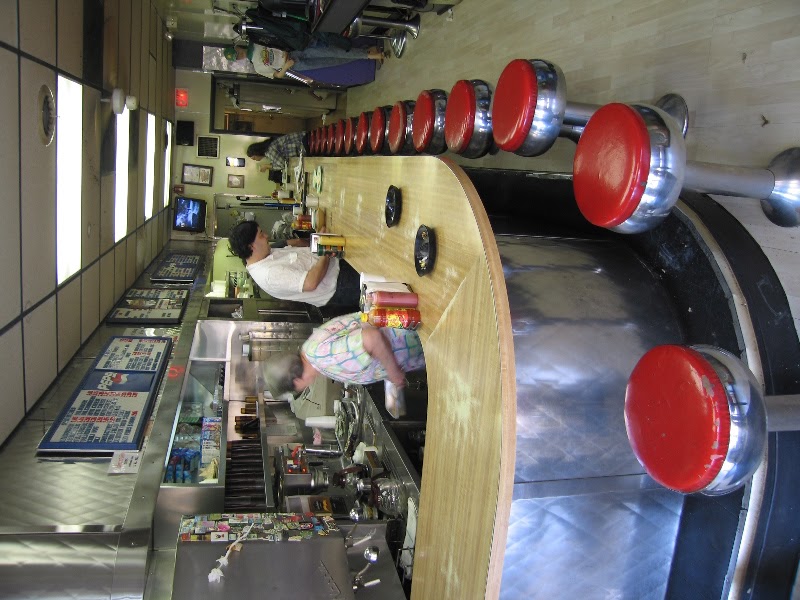
Little did I know, as I entered Tiffany’s Original Diner, passing the jukebox and the pinball machine huddled at the front like they were trying to leave, disappointment awaited me at the counter.

I’m not referring to Janet B. Women with stenciled eyebrows are sometimes hard to read, but Janet was straightforward with her “I value you no more and no less than the thousands upon thousands of customers that I’ve served” attitude, which is really quite a high level of value.

I was dropping in on Tiffany’s during off-hours—that being twelve-thirty in the afternoon. A man named Greg, who seemed to be the owner and was working with Doug to repair the flattop grill, said that the first rush comes as the local bars close, followed by a second rush of bar employees.

Maybe I came at a bad time. Greg was digging years-old grill grime out of the diner’s primary appliance with a butter knife. Janet was waiting for “the new kid” to show up and send her home.

“He’s got one minute,” she said. “Who shows up only one minute before work?”

“I always get to work an hour early,” a customer said.

“He does,” the guy beside him said.

Including me, only two of the seven people engaged with their various tasks (service, repair, patronage and crossword puzzle solving) weren’t smoking. John threw open the door and took a deep breath like he’d just run several blocks.

Variations on “Just made it!” and “Close call!” arose from all sides of the rectangular box of a restaurant.

“I heard you guys put grits in your pancakes,” I said to Janet.

“No, we don’t,” she said.

Disappointment can be crushing. I had believed that my information was reliable. With my only reason for visiting this appetite-smothering eatery flipped like gristle into the void, I was suddenly disoriented. The yellowed menu board offered little direction.

“What’s the Tibey?” I asked.

“It’s gravy all over your breakfast,” Janet said.

“What’s the Slinger?”

“It’s chili all over your breakfast.”

Like so many heroes, I was faced with a choice between greatness and survival.

“I’ll just have the biscuits and gravy,” I said.

“Is that all?” Janet asked.

“And a coffee,” I said.

“Don’t make me beg for a refill,” the crossword lady said.

“No woman begs to me with clothes on,” Greg said.

“Is that it?” Janet asked me.

“And a egg,” I said.

“Biscuits and gravy, John!” she yelled.

John, who was still sweating and could not access the temporary grill station due to the repair work, thrust himself against the laminate.

“I don’t know if my ass is supposed to be on the counter,” he said.

“It’s not like you’re going to shit on it,” Doug said.

John’s legs managed to clear the condiments and napkin dispensers, and he even made a show of spritzing some sanitizer for my benefit.

“This gravy is a little watery,” he said, looking into a bucket.

“It don’t make any difference,” Janet said.

“Zap it,” Greg said.

“Pitch it?” John asked.

“No!” Janet said.

“I could combine it with this fresh one,” John said.

“Don’t mix ‘em together!” Greg said.

A knowing look circulated the room like, “The new guy.”

“How long have you worked here?” I asked John.

“Four months,” he said.

“What about Janet?”

“Decades, man,” he said. “Her whole freakin’ life. I couldn’t do it. I want out already.”

Having topped off everyone’s coffee, Janet put on her coat and found her duffle bag-sized purse. On her way to the door, she leaned across the counter and kissed Greg on the lips. It was a sweet, mother-son kind of kiss.

“What, no French?” Doug asked.

“Not today, ma chérie,” Greg said, with a seemingly accurate French accent.

“See you guys tomorrow,” Janet said.

“Bye, Janet,” I said, feeling like a member of the family.